
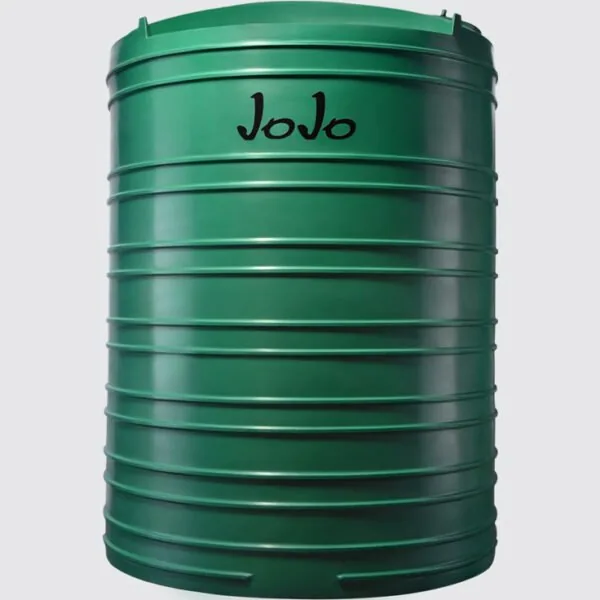
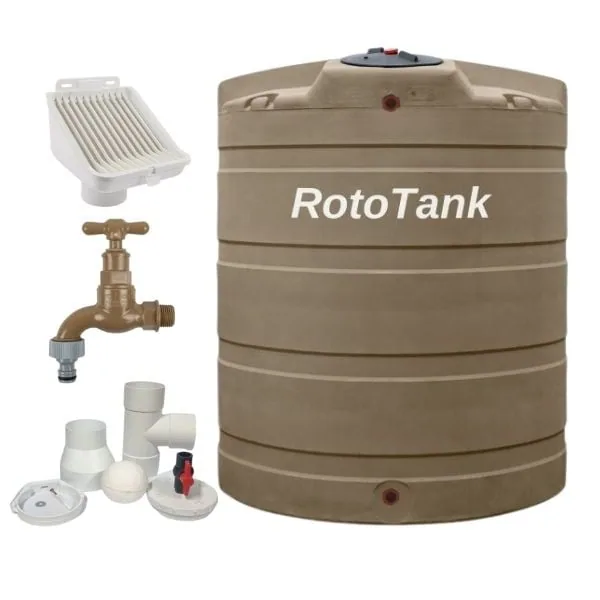
Quick answer: Every millimetre of rain on one square metre of roof gives about one litre of water. Multiply your roof’s footprint area by annual rainfall, then by roughly 0.8 to allow for losses, to get your yearly yield. In South Africa you may store and use roof runoff, subject to local by-laws. Add a first flush diverter, gutters and a tank sized to your dry season, and treat the water before drinking it.
How much water can my roof actually catch?
The basic formula is simple: litres per year = roof area (m2) x annual rainfall (mm) x runoff coefficient. Use the horizontal footprint of the roof, not the sloped surface. The runoff coefficient covers splash, evaporation, leaks and the water you throw away in a first flush. A planning figure of about 0.85 is common in online yield calculators, and a lower figure is safer for old or rough roofs (see the data-driven AEC calculator in the Sources).
Rainfall differs hugely across the country. Parts of the Western Cape and Eastern Cape coast get steady winter or all-year rain, while much of the Highveld and Limpopo gets almost all of its rain in summer thunderstorms. Look up the long-term average for your nearest town, then be conservative, because dry years happen.
Is rainwater harvesting legal in South Africa?
Yes. Schedule 1 of the National Water Act lists storing and using run-off water from a roof as something a person may do. That right is not absolute. The Act says it is subject to other laws, ordinances, by-laws and regulations.
In practice, check with your municipality before you build. Some metros and building-plan offices have rules on tank position, overflow routing, mosquito-proofing and connection to municipal plumbing. Never connect a rainwater tank directly to the municipal supply pipe, because backflow can contaminate the network.
Standards are moving too. The SAISC notes that SANS 1088, on water efficiency in buildings, was published in December 2019 and is expected to feed into the building regulations as SANS 10400-XB. It also notes that raw harvested rainwater is not regarded as potable under water services legislation, so storage should carry a warning.
Are there rebates for rainwater tanks?
We could not verify a national rebate or subsidy for household rainwater tanks in South Africa, so budget on paying the full cost yourself. Some municipalities run water-saving campaigns or tariffs that reward lower use, and these change often. Ask your local water department what is currently on offer.
The saving is more likely to come from your bill. Cape Town’s water outlook was rated 4 out of 10 in early 2026, with dams at around 60%, and the City asked households to cut consumption by at least 10% (EWN, February 2026). Tariffs and restrictions in drought-prone areas make every free litre from the roof more valuable.
What do I need besides a tank?
A working system has five parts:
- Clean gutters and downpipes that carry water to one collection point.
- A first flush diverter that sends the dirtiest first rain away from the tank. One rule of thumb from the University-level text To Catch the Rain is that contamination is halved for each millimetre of rainfall flushed away.
- A leaf screen or mesh at the inlet to keep debris and mosquitoes out.
- A tank on a firm, level base, with an overflow pipe that drains away from foundations.
- A way to get the water out: gravity to a garden tap, or a small pump for pressure.
If you do not want to source the parts one by one, the rainwater harvesting kits listed in our rainwater harvesting category bundle a tank with a first flush device.
How big should my rainwater tank be?
Size the tank to bridge your longest dry spell, not to hold a full year of rain. In a summer-rainfall area with a dry winter of five to six months, you want enough storage to cover the non-drinking demand for that stretch, up to the limit of what your roof can fill.
| Roof footprint | Rainfall assumed | Yearly yield at 0.8 | Sensible tank range |
|---|---|---|---|
| 60 m2 (small house) | 600 mm | 28,800 L | 2,500 to 5,000 L |
| 150 m2 (family house) | 600 mm | 72,000 L | 5,000 to 10,000 L |
| 300 m2 (house plus garage or shed) | 600 mm | 144,000 L | 10,000 to 20,000 L |
| 1,000 m2 (farm shed) | 600 mm | 480,000 L | 20,000 L and up, or several tanks |
The 600 mm figure is an example only. Replace it with the average for your area. The tank range is a practical guide, not a standard.
Worked example: a family house in Polokwane
Say a family of four has a 150 m2 roof footprint and wants rainwater for the garden, toilets and washing the car. Assume 600 mm of rain a year (use your local figure) and a coefficient of 0.8.
- Yield: 150 x 600 x 0.8 = 72,000 litres a year.
- Demand: if the household uses 150 litres a day on garden and toilets, that is 54,750 litres a year.
- Dry season: over about 180 dry days, the household needs roughly 27,000 litres from storage.
A single 5,000 litre tank covers about a month of that demand in the dry season. So the household either adds tanks, or cuts demand by watering with a drip system and keeping the tank for the toilets and essentials. Both are realistic. Even one tank saves a meaningful amount of municipal water through the wet months, when it fills several times over.
How much does a rainwater harvesting setup cost?
Prices below are current Kamano prices, VAT included. See the full range in our water tanks category.
For the Polokwane family above, a 5,000 L kit at R5,376 is the entry point for a garden and toilet system. If you want pressure at a tap without carrying buckets, the pump combo at R4,028 pairs a 2,200 L tank with a small pump. You can also look at our tank and pump combo kits.
Delivery is by Kamano’s own trucks to all 9 provinces in 1 to 3 business days. Fees by order weight, VAT included, are R550 up to 30 kg, R950 up to 60 kg and R1,450 up to 100 kg. Over 100 kg is quoted. Orders of R20,000 or more get free delivery with coupon code KH027, which does not work below R20,000. See the Polokwane delivery page for details. Payment is by EFT, and trade or bulk buyers can request a quote at our quote page.
Can I drink rainwater from my tank?
Not without treatment. Roofs collect bird droppings, dust, leaves and sometimes chemicals, so treat raw rainwater as non-drinking water unless you filter and disinfect it. A sediment filter followed by carbon and a UV unit is the usual home approach. A 5 micron sediment cartridge costs R203, and the UV unit above is R2,000. Our guide to making borehole or tank water safe covers the steps and testing, and our backup water system guide shows how to combine tank, pump, filter and UV.
Avoid harvesting from roofs with asbestos sheeting, and be careful with roofs treated with lead-based paint or certain coatings. If in doubt, use the water for the garden only.
Buying from outside South Africa?
Kamano’s standard delivery covers South Africa only. Buyers in Botswana, Zimbabwe, Namibia, Mozambique, Eswatini and Lesotho should contact Kamano before ordering to discuss cross-border options. Call or WhatsApp +27 73 679 0837 or email sales@kamanoindustrial.co.za.
Sources
- National Water Act, Schedule 1: permissible use of water (Acts Online)
- Rainwater harvesting, SAISC technical article
- Rainwater harvesting calculator and yield formula (Data Driven AEC)
- To Catch the Rain, chapter 4: Calculations (LibreTexts)
- Cape Town water outlook rated 4/10 as dam levels hover at 60% (EWN, 5 February 2026)
Frequently asked questions
How many litres of water can a roof collect?
Roughly one litre per square metre for every millimetre of rain. Multiply the horizontal roof footprint by annual rainfall in millimetres, then by a runoff coefficient of about 0.8 to allow for losses. A 150 square metre roof in a 600 mm area yields about 72,000 litres a year.
Is it legal to collect rainwater in South Africa?
Yes. Schedule 1 of the National Water Act lets a person store and use run-off water from a roof. It is subject to other laws and municipal by-laws, so check with your local municipality about tank placement, overflows and plumbing rules before installing.
What size rainwater tank do I need?
Match the tank to your longest dry spell and your non-drinking demand, not to the full annual yield. Many homes do well with 2,500 to 10,000 litres. Calculate daily use, multiply by the number of dry days, and compare that with what your roof can fill.
Is rainwater safe to drink?
Not straight from the tank. Raw rainwater is not considered potable and can carry droppings, dust and microbes from the roof. Use a first flush diverter, then a sediment filter, carbon filter and UV unit, and test the water if you plan to drink it.