
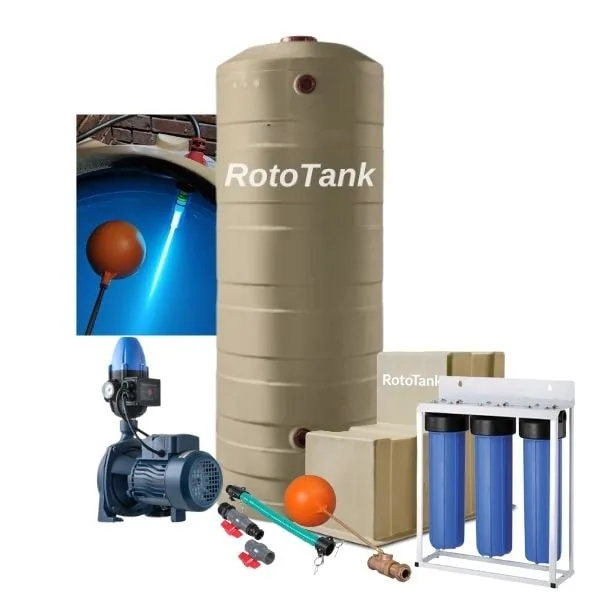
Quick answer: A full-house backup water system has four parts: a storage tank sized at roughly 150 litres per person per day for the days you want covered, a booster pump to give taps proper pressure, a sediment and carbon filter, and UV to treat bacteria. For a family of four, a 5,000 L tank (R4,452), a 0.75 kW booster combo (R2,808), a 3-stage filter (R2,079) and an in-line UV steriliser (R2,000) come to R11,339 at current store prices.
Why build a backup water system now?
Outages are no longer rare. Johannesburg Water warned residents ahead of a 12-hour Rand Water and Eskom maintenance shutdown on Friday 17 July 2026, advising them to store enough water for essential use. The same report notes that after earlier maintenance, large areas went without water for more than 14 days. A separate report counted at least 22 major outages in Johannesburg between 31 December 2025 and mid-February 2026.
A backup system turns that disruption into a minor inconvenience. Water in the tank keeps the geyser, toilets and taps running, and filtration and UV keep it safe to drink.
What are the four parts of a backup water system?
| Part | Job | Kamano example | Price |
|---|---|---|---|
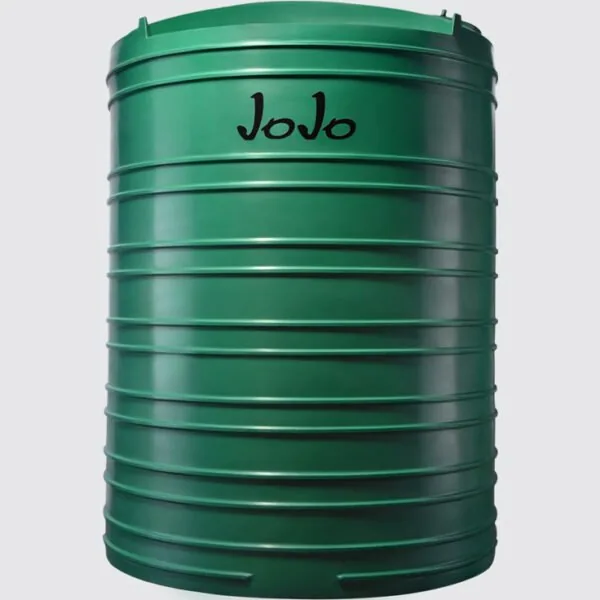
| Tank | Stores the reserve; fills from the mains or roof when supply returns | 5,000 L vertical water tank | R4,452 |
| Pump | Gives pressure to taps, showers and appliances | QB80 0.75 kW booster combo | R2,808 |
| Filter | Removes sediment, improves taste | Big Blue 20 inch 3-stage filter set | R2,079 |
| UV | Treats bacteria and viruses | 55 W in-line UV steriliser, 2,720 L/h | R2,000 |
Our tank size guide covers the first part in detail, and the booster pump guide covers the second.
How big should the tank be?
Tank suppliers commonly plan on 150 litres per person per day. Multiply by the household size and the days you want covered, then add a margin. A family of four needs 600 litres a day, so three days is 1,800 litres, and a week is 4,200 litres.
If you only want drinking, cooking and flushing during a long cut, you can stretch the reserve by cutting out garden and car washing. Johannesburg Water’s own advice during shutdowns is to avoid washing cars and filling pools. For bigger needs, the water tanks range runs from 260 L to 20,000 L.
Which pump should I use?
The pump sits beside the tank and pushes water into the house plumbing. JoJo’s guidance is 0.37 kW for small homes, 0.55 to 0.75 kW for medium households and 1.1 kW for large homes and gardens, with variable-speed pumps for steady pressure. Fit ball valves either side of the tank so you can isolate the supply.
A tank on the ground does not feed the house by gravity in any useful way. A tank on a 3 m stand gives only about 0.3 bar, while municipal supply is typically about 4 bar, so the pump matters. See the water booster pumps range, and have a plumber handle any connection to the municipal main, with a non-return valve so tank water cannot flow back into the street supply.
Do I need a filter and UV as well?
If you will drink or cook with tank water, yes. JoJo explains that sediment filters remove visible particles such as sand, rust and dirt, activated carbon improves taste and smell by taking out chlorine and organic compounds, and UV treats bacteria and viruses. UV units are often combined with other filters for extra protection. JoJo also advises testing your water source, because municipal, borehole and rainwater need different treatment.
Put the filters before the UV unit, so the water reaching the lamp is clear. UV works on clear water, and the in-line unit listed above is rated at 2,720 L/h, which is about 45 L/min. A strong pump can move more than that, so match flow to the unit or feed only the drinking line through it.
- 20 inch slim 3-stage wall-mounted filtration system: R1,080.
- 55 W submersible UV-C tank light for 2,000 to 5,000 L tanks: R2,990, which treats water in the tank itself.
- Replacement 20 inch sediment cartridge, 5 micron: R203. Replacement 55 W UV lamp: R440.
Browse the water filters range. For the next step, our guide to treating borehole and tank water goes deeper.
Worked example: a Johannesburg family of four
The family lives in Johannesburg, where shutdowns can last from 12 hours to days. They want three days of cover (1,800 L) plus a buffer, and they want safe drinking water. They choose a 5,000 L tank, which also leaves room to collect rainwater later.
- 5,000 L vertical tank: R4,452
- QB80 0.75 kW booster combo: R2,808
- Big Blue 3-stage filter set: R2,079
- 55 W in-line UV steriliser: R2,000
The total is R11,339, plus a slab, pipework and a plumber for the municipal connection. Daily use of 600 L means the full tank would last more than eight days if they stay careful, though in practice it will be shared with a garden.
A cheaper, compact option
If space or budget is tight, the 800 L tank combo with a 0.75 kW pump, UV light and filters is R10,640 and arrives as a single package. For constant pressure, the 800 L combo with a RUC-750 smart VSD pump is R13,516. An 800 L tank covers about a day for four people, so it suits flats and townhouses better than a long outage.
What should I budget for a backup water system?
- Basic (tank and pump): from about R7,260 using the 5,000 L tank and QB80 combo.
- Drinking-safe system: about R11,339 as above.
- Compact all-in-one: R10,640 to R13,516 for the 800 L combos.
- Running costs: filter cartridges and a UV lamp every so often, plus the pump’s electricity. Add a generator or solar input if you want water during load shedding.
Also browse the tank and pump combo kits.
Will the pump work when the power is off?
Not unless you plan for it. A booster pump needs electricity, so during load shedding or a power cut the tank will still hold water but the taps may run dry. JoJo suggests pairing the pump with backup power such as solar or a generator to keep water flowing through outages.
For a small household, a generator or inverter sized for the pump’s running and starting load is usually enough. Ask an electrician to size it, because motors draw more current when they start. If power is the weak point, a low-pressure gravity tap on the tank is a simple emergency fallback for drinking water.
How do I keep stored water safe?
- Cover the tank and fit insect screens on vents and overflows.
- Clean the tank before first use and every so often afterwards.
- Keep the tank out of direct sun where possible to slow algae growth.
- Turn the water over: the CDC suggests replacing stored tap water every 6 months in small containers, and the same habit of rotation applies to a tank.
- Test the water, and replace filters and UV lamps on schedule.
How does delivery work?
Kamano delivers with its own trucks to all 9 provinces in 1 to 3 business days. Fees are by order weight, VAT included: R550 up to 30 kg, R950 up to 60 kg and R1,450 up to 100 kg, and anything over 100 kg is quoted. Orders of R20,000 or more get free delivery with coupon code KH027 (the code does not work below R20,000). Check delivery to Johannesburg for Gauteng timing. Payment is by EFT. For trade and bulk quotes use the quote page, call or WhatsApp +27 73 679 0837, or email sales@kamanoindustrial.co.za.
Buying from outside South Africa?
Kamano’s standard delivery covers South Africa only. Buyers in Botswana, Zimbabwe, Namibia, Mozambique, Eswatini and Lesotho should contact Kamano before ordering to discuss cross-border options.
Sources
- Daily Maverick: Joburg braces for another water maintenance shutdown (15 July 2026)
- AllAfrica (Our City News): Johannesburg’s water woes continue into 2026
- JoJo: what water filtration device do you need and why
- JoJo: how pressure booster pumps send water from your storage tank into your home
- Daily Maverick: backup water tank options for your home
- CDC: how to create and store an emergency water supply
Frequently asked questions
What do I need for a backup water system at home?
Four parts: a storage tank sized at about 150 litres per person per day for the days you want covered, a booster pump for pressure, a sediment and carbon filter, and UV to treat bacteria. For a family of four, a 5,000 L tank, 0.75 kW pump, 3-stage filter and UV unit come to R11,339 at Kamano.
How big a tank do I need for a water outage?
Multiply 150 litres by the number of people and by the days of cover, then add a margin. A family of four needs 600 litres a day, so three days is 1,800 litres and a week is 4,200 litres. A 2,400 L or 5,000 L tank is the usual choice.
Is tank water safe to drink?
Not automatically. Stored water can pick up dirt and bacteria, so filter out sediment and treat with UV before drinking, and test your water source. Keep the tank covered and out of direct sun, and replace filter cartridges and UV lamps on schedule.
Can I connect my tank and pump to the municipal supply?
Connecting to the mains needs care. By-laws differ between municipalities, and the connection should include a non-return valve so tank water cannot flow back into the street supply. Ask your municipality first and have a qualified plumber do the work.