
Quick answer: For low municipal pressure or tank backup, pair a booster pump with a storage tank rather than pumping straight off the mains. A 0.37 to 0.55 kW pump suits one or two taps, 0.55 to 0.75 kW suits a typical family home, and 1.1 kW suits large houses and gardens. A pressure-switch pump is the cheaper option, while a variable-speed (VSD) pump holds steady pressure and uses less energy. Add a small pressure tank to stop the pump cycling.
Why is my water pressure low, and will a booster pump fix it?
Low pressure has two usual causes: the municipal supply is weak at your property, or you are drawing from a tank sitting on the ground or on a short stand. A booster pump fixes both, as long as there is water to pump. It cannot create water, so if the mains is dry, you need a tank behind the pump.
Gravity is a poor substitute. JoJo notes that a tank on a 3 m steel stand gives only about 0.3 bar, while municipal supply is typically around 4 bar. A pressure pump delivers 4 to 6 bar. As a rule of thumb, 10 m of height gives 1 bar.
Can I connect a booster pump straight to the municipal supply?
Often you should not. Grundfos warns that boosting directly from the mains is not legal in some countries, and tells installers to check local rules first. In South Africa, municipal water by-laws vary. The City of Cape Town’s 2010 water by-law, for example, makes owners responsible for their own arrangements if they need a specific pressure or flow, and forbids connecting equipment that could cause pressure surges in the supply system.
The safest and most common design is mains to tank to pump to house. The tank holds an emergency reserve, protects the municipal network from sudden demand, and gives the pump a steady supply. Ask your municipality before connecting anything to the mains side, and use a plumber for that connection.
What size booster pump do I need?
Match the pump to the number of taps that run at the same time, not the number of people. JoJo’s guide groups pumps like this:
| Pump | Suits | Typical flow and pressure (JoJo ranges) | Kamano example | Price |
|---|---|---|---|---|
| 0.37 kW | Small homes, a couple of taps | about 10 to 20 L/min at 1.0 to 2.4 bar | QB-60 booster combo with pressure switch | R1,680 |
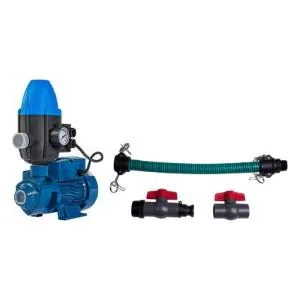
| 0.55 to 0.75 kW | Medium households, several outlets | about 30 to 80 L/min at 1.6 to 2.8 bar | QB80 0.75 kW booster combo with suction hose kit | R2,808 |
| 1.1 kW | Large homes, gardens, irrigation | about 40 to 90 L/min at 2.7 to 3.5 bar | CPM170 1.1 kW booster combo with flow controller | R4,448 |
| 0.37 kW VSD (constant pressure) | Steady pressure at lower power | about 25 to 58 L/min at 1 to 2.2 bar | RUC 370 Smart VSD booster pump | R5,192 |
The ranges are best-efficiency figures quoted by JoJo for its own pump families, so use them as a guide and check the curve for the model you buy. Browse the full water booster pumps range.
Pressure switch or VSD: which is better?
A standard booster pump starts and stops on a pressure switch or flow controller. It is cheap and simple, but pressure swings between on and off, and the motor restarts often.
A VSD pump adjusts its speed to hold a set pressure. Grundfos explains that a constant-pressure pump adds only what is missing: with a 4 bar setpoint and 2 bar at the mains, it adds about 2 bar and keeps the total at 4 bar whatever the mains does. JoJo notes that VSD pumps hold steady pressure and use less energy.
- Choose a pressure switch if budget matters, the house has a few taps and you can tolerate some pressure swing.
- Choose a VSD if you have showers on mixer taps, several bathrooms, or want quiet, steady pressure.
Do I need a pressure tank?
With a pressure-switch pump, yes. A small pressure tank holds a cushion of pressurised water so the pump does not start every time a tap opens briefly. It reduces wear and smooths out surges. VSD pumps need only a very small tank, which is why the store sells 2 L and 3 L tanks for VSD kits.
- 24 L vertical steel pressure tank, 8 bar: R760.
- 2 L pressure tank for VSD booster kits: R248.
- Pressure switch, 1 to 6 bar: R110. Pressure gauge: R66.
See also the pump controllers and VSD accessories.
Worked example: a Pretoria family on weak municipal pressure
A family of four lives in Pretoria with two bathrooms. The mains trickles in during the day and fails twice a week. They put a 2,400 L tank on a slab and add a booster pump so the house runs from the tank.
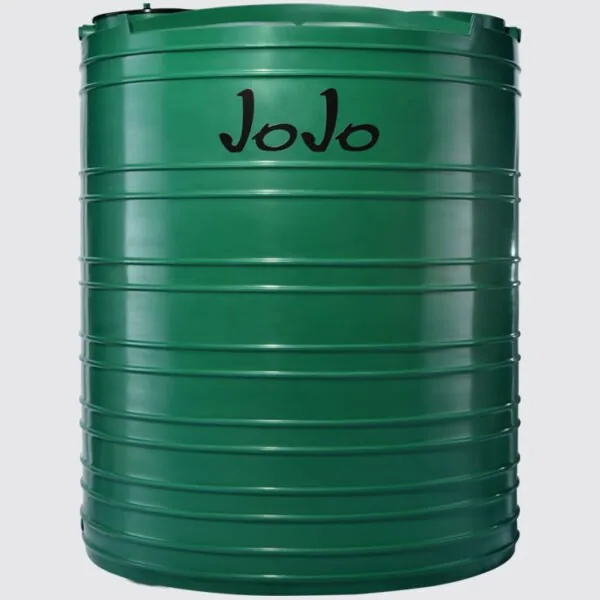
Assume two showers and a kitchen tap run at once, at about 10 L/min each, so peak demand is about 30 L/min. A 0.75 kW pump delivering 40 to 80 L/min is comfortable. They choose the QB80 combo at R2,808, a 24 L pressure tank at R760 and the JoJo 2,400 L tank at R3,402. The total for tank, pump and pressure tank is R6,970, before pipework, fittings and a slab.
If they prefer quiet, steady showers, they could swap the pump for the RUC 370 Smart VSD at R5,192. Tank and pump then come to R8,594, and a small VSD pressure tank adds R248 to R408.
What does a booster system cost in 2026?
- Basic booster pump with pressure switch: from R1,680.
- Family-size 0.75 kW combo: about R2,808 to R3,416.
- VSD constant-pressure pump: from R5,192 (0.37 kW) to R13,413 for the Esybox Mini 3 0.75 kW variable-speed pump.
- Tank and pump already combined: the 800 L tank combo with a 0.55 kW booster pump is R5,220. See all tank and pump combo kits.
For storage, see the water tanks range. To add filtration and UV for drinking water, read our guide to a full-house backup water system.
What mistakes cause booster pump problems?
- Starving the pump. A pump that sucks air or sits above a low tank will lose prime. Keep the suction pipe short, the right diameter and airtight.
- Choosing by kW alone. Look at flow and pressure at the point you need, not just motor size.
- Ignoring maximum pressure. Grundfos points out that inlet pressure adds to pump pressure. A 2 bar supply plus a 5 bar pump makes 7 bar, which would exceed a pump rated at 6 bar.
- Forgetting a dry-run plan. If the tank empties, an unprotected pump can overheat. Ask about protection when you order, and see the pump automatic control unit at R480.
Where should I install the pump?
- Next to the tank, with ball valves on both sides so you can isolate it for service. JoJo recommends this layout.
- Under a cover or in a ventilated shed. JoJo notes a pump cover may be required to keep the warranty valid.
- With backup power such as a generator or solar if you want water during load shedding or outages.
Noise matters too. Grundfos suggests quiet pumps for indoor installations and for outdoor ones near neighbours, since pumps may run at night.
How does delivery work?
Kamano delivers with its own trucks to all 9 provinces in 1 to 3 business days. Fees are by order weight, VAT included: R550 up to 30 kg, R950 up to 60 kg and R1,450 up to 100 kg, and anything over 100 kg is quoted. Orders of R20,000 or more get free delivery with coupon code KH027 (the code does not work below R20,000). Check delivery to Johannesburg for Gauteng timing. Payment is by EFT. For trade and bulk quotes use the quote page, call or WhatsApp +27 73 679 0837, or email sales@kamanoindustrial.co.za.
Buying from outside South Africa?
Kamano’s standard delivery covers South Africa only. Buyers in Botswana, Zimbabwe, Namibia, Mozambique, Eswatini and Lesotho should contact Kamano before ordering to discuss cross-border options.
Sources
- JoJo: how pressure booster pumps send water from your storage tank into your home
- Grundfos: how to select the right pump for boosting mains water
- City of Cape Town Water By-law 2010 (Open By-laws)
- JoJo: choosing and installing your JoJo tank
Frequently asked questions
What size booster pump do I need for a house?
Match the pump to how many taps run at once. JoJo suggests 0.37 kW for small homes with a couple of taps, 0.55 to 0.75 kW for medium households with several outlets, and 1.1 kW for large homes and gardens. Check the pump curve for flow at the pressure you need.
Should I connect a booster pump directly to the municipal water supply?
It is safer not to. Boosting straight off the mains is restricted in some places, and by-laws differ between municipalities. The usual design is mains to tank to pump to house. Ask your municipality before connecting to the mains side and have a plumber do the work.
Is a VSD booster pump worth the extra cost?
A VSD pump holds steady pressure and uses less energy, which suits showers, several bathrooms and quiet operation. A pressure-switch pump costs less and is fine for homes with a few taps. At Kamano, a VSD pump starts at R5,192 and a switch-based combo at R1,680.
Do I need a pressure tank with a booster pump?
With a pressure-switch pump, yes. A small pressure tank, such as a 24 L tank at R760, stops the pump starting each time a tap opens briefly. VSD pumps need only a very small tank, and the store lists 2 L and 3 L tanks for VSD booster kits.