
Quick answer: A honey sucker is a tank with a suction pump that empties septic tanks, sumps, sewer blockages and portable toilets. Small skid units of 500 L to 1,000 L suit a bakkie and light jobs, 1,500 L to 2,500 L units suit busy contractors, and large municipal vacuum tankers hold 10 to 55 m³. Kamano honey suckers range from R16,055.55 to R83,160.00, VAT included.
What is a honey sucker and how does it work?
A honey sucker, or vacuum tanker, uses a pump to pull liquid, sludge or slurry out of a tank or pit and into its own tank. It then carries the load to a place where it can be discharged legally.
A general reference on vacuum trucks explains that the pump creates suction, which is why the lift is limited: atmospheric pressure can raise water only about 10.3 metres in theory, and thick sludge with some air mixed in gives a practical lift of roughly 10 to 15 metres. Suction hoses are usually 2 to 4 inches in diameter and rarely run beyond about 50 metres.
Tankers are normally emptied by gravity. The same reference gives about 7 to 10 minutes to empty a 4,000-litre tanker, which helps when you plan a day’s route.
What are honey suckers used for?
- Septic tanks and conservancy tanks on homes, farms, lodges and schools. See our septic vs conservancy tank guide for how often they need emptying.
- Portable and event toilets, construction-site toilets and pit latrines.
- Sewer blockages, sumps and pump stations for municipalities and plumbing contractors.
- Mines, factories and farms that need to remove sludge, silt and wash-down water from sumps or dams.
Septic tanks are generally emptied every 2 to 5 years, according to the Sustainable Sanitation and Water Management toolbox. It also gives a practical trigger: desludge when sludge and scum fill about half to two-thirds of the depth below the water level. Tanks that go too long can let solids pass through to the soakaway.
Which size do you need?
Match the tanker to the biggest job you do most often and the vehicle that will carry it. Water and sewage are heavy, since 1,000 L of liquid weighs about a tonne. A 2,500 L load is more than a typical bakkie should carry, so that size goes on a truck or a braked double-axle trailer.
| Capacity | Format | Best for | Kamano example and price |
|---|---|---|---|
| 500 L | Skid, petrol | Small tanks, tight access, single operator | 500 L skid unit: R18,701.55 |
| 1,000 L | IBC skid, petrol | Lowest cost start, bakkie mounting | 1,000 L IBC skid unit: R16,055.55 |
| 1,000 L | IBC trailer, braked | Towing from site to site | 1,000 L IBC trailer, 1.6 t braked axle: R45,350.55 |
| 1,500 L | Skid, petrol | Regular septic work | 1,500 L skid unit: R22,954.05 |
| 2,500 L | Truck unit, petrol | Contractors, larger sumps | 2,500 L truck unit: R41,759.55 |
| 2,500 L | Double-axle trailer, braked | Heavy-duty towed work | 2,500 L trailer: R82,489.05 |
For comparison, a South African truck-body maker lists large vacuum tankers of 24,000, 36,000 and 48,000 litres, and a general reference says commercial fecal sludge trucks hold 10 to 55 cubic metres. Those are municipal and industrial machines. The units above are for smaller jobs where a big truck cannot reach or is not worth the call-out.
Skid, trailer or truck unit?
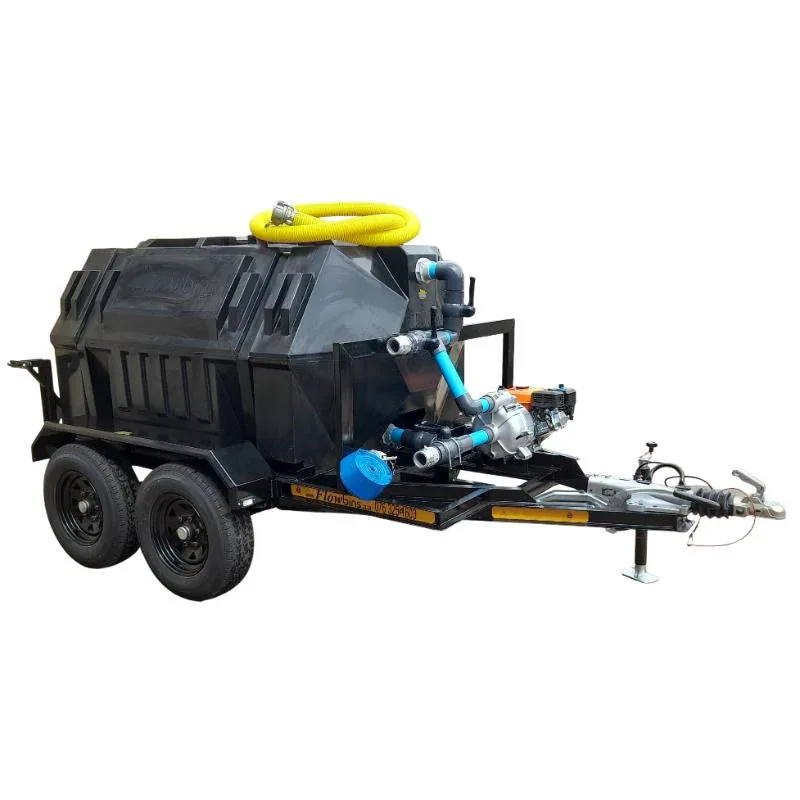
Skid units bolt onto a bakkie bed or a flatbed. They are the cheapest way into the business and are easy to store, but your vehicle carries all the weight.
Trailers are towed, so the bakkie stays free for other work. Kamano lists braked and unbraked versions. Braked axles stop heavier loads more safely, so choose braked for anything above 1,000 L and check your vehicle’s towing rating.
Truck units are tanks and pumps fitted to a truck chassis you already own. Combination trailers also exist: the honey sucker and water bowser combo, 2 x 1,000 L, diesel is R83,160.00, and a version with a 186 bar pressure washer on board is R59,724.00. See all options in our honey suckers category.
Where can you legally empty the load?
This is the question that separates a legitimate operator from a problem. In June 2026 the Knysna-Plett Herald reported video footage that experts believed showed a honey sucker dumping effluent illegally. The experts said tanker contents should normally go to a designated sewage pump station or wastewater treatment works, and the case was referred to the Green Scorpions for investigation.
Before you start trading, ask your municipality where it accepts hauled waste, what it charges and whether you need approval. Keep records of every load. Never discharge to stormwater, rivers or open ground. If you are unsure, ask your local water services authority.
A worked example: a Limpopo plumbing contractor
A contractor near Polokwane services farm septic tanks of about 4,000 L each.
- With a 1,000 L skid, each tank takes four loads, and four trips to the dump point.
- With a 2,500 L truck unit, each tank takes two loads.
- At roughly 7 to 10 minutes to discharge a 4,000 L tanker by gravity, a 2,500 L load is a quick unload, so the real time goes on driving and hose work.
If the dump point is 30 minutes away, halving the trips saves hours per tank. That is why the R41,759.55 truck unit often pays back faster than the cheaper R16,055.55 skid on a busy route. If you do only a few tanks a month, the smaller unit makes more sense.
What should you budget?
- Starter: 1,000 L IBC skid at R16,055.55, or R25,316.55 for the diesel version.
- Mid-range: 1,500 L to 2,000 L skid, R22,954.05 to R32,608.80.
- Heavy: 2,500 L truck unit at R41,759.55, or the towed trailer at R82,489.05.
Also budget for suction and discharge hoses, PPE, a vehicle that can carry the weight, registration and fuel. Wash your unit and hoses after each job. A pressure washer makes this quick.
Kamano delivers by its own trucks to all 9 provinces in 1 to 3 business days. Fees by order weight, VAT included, are R550 up to 30 kg, R950 up to 60 kg and R1,450 up to 100 kg. Orders over 100 kg are quoted, which covers most tanker units. Orders of R20,000 or more qualify for free delivery with coupon code KH027, which does not work below R20,000. See delivery to Johannesburg. Payment is by EFT. Municipalities, contractors and resellers can request a bulk price on our quote page.
Municipal needs: why smaller units still matter
In May 2025 the Democratic Alliance said a municipal honeysucker serving Strydenburg and Hopetown in the Northern Cape had been largely out of operation since January, with sewage surfacing in yards. That is a political statement, but it shows what happens when a single truck is the only option. Smaller backup units let a municipality or contractor reach blockages and failing tanks while the main fleet is under repair.
Buying from outside South Africa?
Kamano’s standard delivery covers South Africa only. Buyers in Botswana, Zimbabwe, Namibia, Mozambique, Eswatini and Lesotho should contact Kamano before ordering to discuss cross-border options. Call or WhatsApp +27 73 679 0837, or email sales@kamanoindustrial.co.za.
Sources
- Wikipedia: Vacuum truck
- SSWM Toolbox: Septic tank factsheet
- Knysna-Plett Herald: Video points to illegal dumping by honeysucker (2 June 2026)
- SA Truck Bodies: Vacuum tanker
- DA Northern Cape: Thembelihle municipality sewerage truck (May 2025)
Frequently asked questions
What size honey sucker do I need?
For small septic tanks and tight access, 500 L to 1,000 L is enough. For regular contractor work, choose 1,500 L to 2,500 L so you make fewer trips. Remember 1,000 L of liquid weighs about a tonne, so match the unit to your vehicle’s carrying and towing capacity.
How often should a septic tank be emptied?
The SSWM toolbox says generally every 2 to 5 years. It suggests emptying when sludge and scum fill about half to two-thirds of the depth below the water level. Household size, tank size and use change the interval, so have the level checked rather than relying only on a calendar.
Where can a honey sucker legally dump waste?
Normally at a designated sewage pump station or wastewater treatment works, as experts said in a June 2026 Knysna report. Never discharge to stormwater, rivers or open ground. Ask your municipality which points accept hauled waste and what approval and fees apply.
Should I buy a skid, trailer or truck-mounted honey sucker?
A skid is cheapest and fits a bakkie or flatbed. A trailer keeps your vehicle free and suits towing between sites, and braked axles are safer for heavier loads. A truck unit suits busy contractors. Choose by volume, vehicle and budget.