

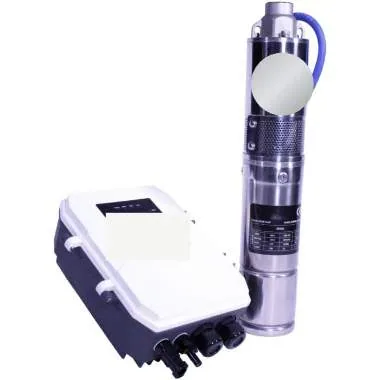
Quick answer: A solar borehole pump needs three inputs: how many litres you use per day, the total head the pump must lift, and what the borehole yields. Size the panels at roughly 1.3 to 1.5 times the pump’s motor power, store water in a tank instead of batteries, and choose DC for small systems, AC with a solar drive for deep or high-flow ones, or a hybrid kit if you want grid or generator backup. Payback is typically 2 to 5 years against diesel or grid power.
How does a solar borehole pump work?
The chain is simple: solar panels feed a controller or drive, which runs a submersible pump, which fills a tank. There are no batteries in a standard design. As EnergyBee puts it in its 2026 guide, water in a tank is far cheaper storage than electricity in a battery. The pump works hardest at midday and slows in the morning, evening and under cloud, and the tank carries you through the night.
That is why solar suits South Africa so well. Rural properties in Limpopo, the Northern Cape and the Free State have strong sun and boreholes far from the power grid, and a solar pump keeps running whatever the grid is doing.
DC, AC or hybrid: which solar pump should I choose?
| Type | How it runs | Best for | Trade-off |
|---|---|---|---|
| DC pump | Panels feed a solar pump controller directly, with no inverter stage | Homes and smallholdings, up to about 1.5 kW | Narrower spares range; hard to add grid or generator backup |
| AC pump with solar drive (VSD) | Panels feed a solar inverter that runs a standard AC motor | Deeper, higher-flow systems, farms and irrigation | Larger array and drive to buy |
| Hybrid kit | Built to run on solar with an extra AC input option (check each listing) | Sites that want a back-up on cloudy days or at night | Costs more than a basic DC set |
Examples from the store: the 750 W 3HR750-140 solar DC borehole pump (140 m head) is R7,104, and the 4SD6/20 hybrid solar borehole pump kit (2.2 kW, 118 m head) is R12,632. Browse the full solar pumps range.
How do I size a solar borehole pump?
- Daily demand: add up household, garden and stock use in litres per day. Our borehole pump guide explains how to work out head and yield.
- Total head: the dynamic water level plus the lift to the tank plus friction. Your driller usually supplies the water levels.
- Yield: never plan to pump more per hour than the borehole gives.
- Array: panel power should be about 1.3 to 1.5 times the pump’s motor power, so a 1.5 kW pump needs about 2.2 kW of panels.
- Worst month: Grundfos advises sizing for the month with the weakest sun. In the Southern Hemisphere that is June to August, so a system that works in winter will have spare capacity in summer.
EnergyBee’s rule-of-thumb table gives a feel for the numbers:
| Total head | Daily demand | Pump size | Panel array |
|---|---|---|---|
| Up to 40 m | 1,000 to 2,500 L | 0.37 to 0.55 kW | 0.7 to 1.1 kW |
| 40 to 80 m | 2,500 to 6,000 L | 0.75 to 1.1 kW | 1.5 to 2.2 kW |
| 80 to 120 m | 6,000 to 12,000 L | 1.5 to 2.2 kW | 2.2 to 3.5 kW |
| 120 to 180 m | 12,000 to 20,000 L | 3 to 4 kW | 4.5 to 6.5 kW |
These are guides, not engineering designs. Confirm with the pump’s curve and the yield test.
Worked example: a small farm in Limpopo
A farm homestead needs about 5,000 litres a day for the house, a vegetable plot and a few animals. The dynamic water level is 60 m and the tank sits 10 m up, so with friction the head is about 75 m. That lands in the 40 to 80 m row, so a 0.75 kW pump and about 1 to 1.5 kW of panels is the right neighbourhood.
At the store, the pump and controller come to R7,104 for the 3HR750-140 pump plus R4,520 for the 3HR750 / 3HR1200 solar pump controller, a total of R11,624. Add panels, mounting, cable and a tank of at least one day’s demand, and ideally two to three days (EnergyBee recommends this), such as the 5,000 L vertical tank at R4,452.
Payback: a quick check
EnergyBee’s own illustration is a farm spending R4,000 a month on diesel with a R90,000 solar system. Divide one by the other and you get 22.5 months, under two years. Your numbers will differ, so replace them with your own monthly fuel or electricity spend.
What does a solar borehole system cost in 2026?
EnergyBee gives installed-cost guidance in rand, including VAT: shallow domestic systems (10 to 40 m) at R25,000 to R45,000, mid-depth household systems (40 to 80 m) at R45,000 to R80,000 and deep, high-flow systems (80 to 150 m) at R80,000 to R120,000. Those figures are third-party installed prices, not Kamano prices. For Kamano parts, current prices are:
- 500 W 3HR500-120 solar DC borehole pump, 120 m head: R6,672.
- 750 W 3HR750-140 solar DC borehole pump, 140 m head: R7,104.
- Solar pump controller for 3HR750 / 3HR1200: R4,520.
- 4SD6/20 hybrid kit, 2.2 kW: R12,632.
- SQB250 solar booster pump combo, 250 W with controller and pressure tank: R5,632.
Running costs are close to zero, but plan on cleaning the panels every month or two and checking the tank float switch. EnergyBee also notes that wiring for an AC system should meet SANS 10142-1 and be signed off with a Certificate of Compliance by a registered electrician.
What mistakes should I avoid with a solar pump?
- Sizing for summer. A system that only works in December will leave you short in July, when sun is weakest and gardens still need water.
- Too small a tank. The tank is your battery. If it holds less than a day of demand, cloudy spells will run you dry.
- Ignoring the yield. A big array can drive a pump faster than the borehole recovers. Match flow to the tested yield and use a well probe so the pump stops when the level is low. The store lists a well probe for 3HR and 3HRI controllers at R296 and a tank level probe at R264.
- Shading the panels. Even a small shadow from a tree or wall can cut output, so mount them clear of obstructions and point them toward the sun.
- Skipping theft planning. Panels are a target on remote farms, so think about fencing or anchoring them well.
Connecting a pump or inverter to a building’s wiring is work for a registered electrician. A simple DC pump with its own panels and no mains connection is much more straightforward.
Is solar really cheaper than grid power or diesel?
Usually, over a few years. Eskom direct customers saw an 8.8% tariff rise from 1 April 2026 and municipal increases of around 9% were expected from July 2026, according to BusinessTech, and diesel adds fuel costs and trips to refill. Solar has no fuel bill, and panels are listed by EnergyBee with a lifespan of about 25 years against 8 to 15 years for the pump.
If you only need pressure at the tap, not borehole lifting, a booster pump may be enough. For storage see the water tanks range.
How does delivery work?
Kamano delivers with its own trucks to all 9 provinces in 1 to 3 business days. Fees are by order weight, VAT included: R550 up to 30 kg, R950 up to 60 kg and R1,450 up to 100 kg, and anything over 100 kg is quoted. Orders of R20,000 or more get free delivery with coupon code KH027 (the code does not work below R20,000). Check delivery to Polokwane for an example. Payment is by EFT. For trade and bulk quotes use the quote page, call or WhatsApp +27 73 679 0837, or email sales@kamanoindustrial.co.za.
Buying from outside South Africa?
Kamano’s standard delivery covers South Africa only. Buyers in Botswana, Zimbabwe, Namibia, Mozambique, Eswatini and Lesotho should contact Kamano before ordering to discuss cross-border options.
Sources
- EnergyBee: solar borehole pumps in South Africa (2026 guide)
- Grundfos: how to size and select a solar water pumping system
- BusinessTech: electricity tariff increases for 2026/27
Frequently asked questions
How many solar panels do I need for a borehole pump?
As a rule of thumb, panel power should be 1.3 to 1.5 times the pump’s motor power. A 0.75 kW pump needs roughly 1 to 1.5 kW of panels, and a 1.5 kW pump about 2.2 kW. Size for the weakest sun of the year, which is winter in South Africa.
Do solar borehole pumps need batteries?
Not normally. The usual design pumps water into a tank while the sun shines and uses the tank as storage. Water in a tank is far cheaper to store than electricity in a battery. Plan on at least one day of demand in the tank, and ideally two to three days.
What is the difference between DC and AC solar pumps?
DC pumps run straight from the panels through a solar controller and suit homes and smallholdings up to about 1.5 kW. AC pumps run through a solar drive and suit deeper, higher-flow systems. Many drives and hybrid kits can also take grid or generator backup.
How long does a solar borehole pump take to pay for itself?
EnergyBee puts payback at 2 to 5 years against a diesel or grid-powered pump. A farm spending R4,000 a month on diesel with a R90,000 system, for example, would recover the cost in about 22 months. Use your own fuel or electricity bill to check.