
Quick answer: Most borehole pump problems come from five causes: a falling water level and dry running, electrical faults such as voltage drop or a failed capacitor, a stuck check valve, sand wearing the pump, or an old worn pump or motor. Start with the simple checks (water level, voltage, fuse, pressure switch, check valve) before pulling the pump. Replace when the cause is wear or when repairs approach the price of a new unit.
Why is my borehole pump tripping?
Tripping means the motor protection cuts the power because it draws too much current or overheats. A UK pump specialist lists the most common cause as motor failure, often from water getting into the cable or from strain caused by wrong pump sizing.
Check these in order:
- Voltage at the pump. A technical guide says voltage at each terminal should be within plus or minus 10% of rated. For a 230 V supply that is about 207 V to 253 V. A long or thin cable on a deep borehole causes voltage drop.
- Start capacitor. A weak capacitor causes erratic starts, overheating and overload trips. It is usually a cheap fix on single-phase motors.
- Cable and joints. Water in a damaged joint or tear will trip the system.
- Dry running. If the water level has dropped, the motor runs hot with no water to cool it.
- Blockages. Sand, debris or iron deposits make the motor work harder and overheat.
Keep the overload switch in a shaded, ventilated place. If it is hot to the touch, it trips more easily.
What causes low pressure or no water?
If the pump runs but delivers little or nothing, work through the likely causes:
- Airlock. Restarting the pump a few times can clear it.
- Stuck or closed check valve. Replace it.
- Water level has dropped. The pump now works against more head than before. Check the level against the original specification.
- Blocked strainer or inlet. Sand or particles block the intake.
- Wrong rotation on a three-phase motor. Check direction and swap two phases.
- Worn pump. Wear opens up clearances and drops flow and pressure.
- Leaks in the pipework. These also cause the pressure switch to cycle often.
Short cycling, where the pump starts and stops frequently, usually points to a faulty pressure switch, a leaking check valve that does not hold pressure, or a leak in the line. A correctly sized pressure tank also reduces starts.
Why is my borehole pump running dry?
Dry running happens when the water level falls below the pump inlet, or the borehole yield is less than the pump pumps. It destroys pumps fast because the water is also the coolant.
Groundwater is not constant. A University of the Western Cape study reported in April 2026 found a long-term drop of roughly 2 m to 17 m between 2007 and 2024 in about 80% of monitored Cape Town boreholes, with sharp falls in dry spells. Your borehole may differ, but the lesson applies anywhere: levels move with drought, neighbouring abstraction and rainfall.
Fixes include a pump protection device, a low-level alarm, and measuring the water level regularly so you know the trend. Pumping less per hour from a low-yield borehole, and storing water in a tank, are better than running the pump flat out. See our guide to choosing a borehole pump for yield, depth and head.
What if my pump is pumping sand?
Sand wears impellers and blocks the pump inlet. First check the suction strainer and pump inlet for blockage. A technical guide says that if the pump draws 3 to 6 times its starting current, it should be dismantled, cleaned, repaired and rebuilt.
Sand also signals a borehole problem, such as a damaged casing or a pump set too deep in the screen zone. If sand keeps returning, speak to your driller before installing another pump.
Quick symptom table
| Symptom | Most likely cause | First check |
|---|---|---|
| Trips immediately | Motor, cable water ingress, capacitor | Cable and joints, capacitor, voltage |
| Runs but no water | Airlock, stuck check valve, low water level | Restart, check valve, water level |
| Low pressure | Worn pump, leak, higher head | Pipework leaks, water level |
| Starts and stops often | Pressure switch, check valve, leak | Switch contacts, pressure tank |
| Sand in water | Screen or casing issue, worn strainer | Inlet and strainer |
| Hot or noisy motor | Voltage drop, dry running, blockage | Voltage at pump, water level |
A worked example: a Limpopo farm pump losing flow
A farmer near Polokwane has a pump set at 90 m. The standing water level was 60 m when the borehole was drilled, but it now measures 85 m after two dry seasons. The pump has only 5 m of water over its inlet, flow has dropped, and the motor trips on hot afternoons.
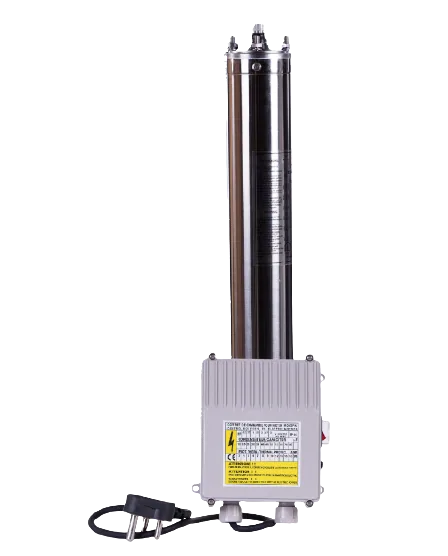
The causes are higher head and a thin water cover, not a faulty motor. Replacing the motor alone would not fix it. The farmer should confirm the yield with the driller, lower the pump if the borehole depth allows it, and fit protection. Check that the new pump matches the new head: for example, the Vega 3″ borehole pump combo kit is rated for 30 to 100 m, while the Vega 4″ kit covers 47 to 81 m.
Should you repair or replace the pump?
Repair if the fault is a capacitor, a check valve, a pressure switch, a cable joint, or a clean-out of a blocked strainer. Replace if:
- the pump is worn and runs well off its curve;
- the motor has failed more than once;
- sand has damaged the stages;
- the water level changed and the pump no longer fits the head.
There is no single lifespan figure that fits every borehole, since water quality, sand, voltage and run time vary. Ask for a quote to pull and repair, and compare it to the cost of a new unit before deciding. Remember that labour, a rig or a hoist and downtime often cost more than the parts. Browse borehole pumps and submersible pumps.
What should you budget?
- Vega 3″ borehole pump combo kit, 2,000 L/h, 30 to 100 m: R2,990
- Vega 4″ borehole pump combo kit, 2,000 L/h, 47 to 81 m: R4,646
- Y1 digital borehole pump controller, 380 V, 0.37 to 4 kW: R2,280
- 60 L vertical steel pressure tank, 8 bar: R1,520
- Mechanical pressure switch, 1 to 6 bar: R110
All prices include VAT. Check the controller’s specification for the protection features you need before ordering. Our pump controllers category lists the options.
Kamano delivers by its own trucks to all 9 provinces in 1 to 3 business days. Fees by order weight, VAT included, are R550 up to 30 kg, R950 up to 60 kg and R1,450 up to 100 kg. Over 100 kg is quoted. Orders of R20,000 or more qualify for free delivery with coupon code KH027, which does not work below R20,000. See delivery to Polokwane. Payment is by EFT. Trade and bulk quotes are on our quote page, or call or WhatsApp +27 73 679 0837.
Buying from outside South Africa?
Kamano’s standard delivery covers South Africa only. Buyers in Botswana, Zimbabwe, Namibia, Mozambique, Eswatini and Lesotho should contact Kamano before ordering to discuss cross-border options. Email sales@kamanoindustrial.co.za with your borehole depth and water level so we can discuss options.
Sources
- Northridge Pumps: Borehole pump troubleshooting guide
- Whisper Pumps: Why does my borehole pump keep tripping?
- TimesLIVE: Worrying decline in Cape Town groundwater levels, UWC study reveals (April 2026)
Frequently asked questions
Why does my borehole pump keep tripping?
Common causes are motor failure, water in the cable, a weak start capacitor, voltage drop on a long cable, blockages from sand, or dry running. Check voltage at the pump (within plus or minus 10%), the cable and joints, the capacitor and the water level before pulling the pump.
Why does my borehole pump run but give no water?
Likely causes are an airlock, a stuck check valve, a blocked strainer, wrong rotation on a three-phase motor, a falling water level or a worn pump. Restart to clear airlocks, check the valve and strainer, then measure the water level against the original specification.
How do I stop my borehole pump running dry?
Know your water level and yield, fit a pump protection device and a low-level alarm, and avoid pumping faster than the borehole recovers. A storage tank lets you pump in shorter cycles. If the level has dropped, the pump may need to be lowered or replaced with a model matched to the new head.
When should I replace a borehole pump instead of repairing it?
Replace when the pump is worn, the motor has failed repeatedly, sand has damaged the stages, or the water level means it no longer suits the head. Repair simple parts like capacitors, check valves, pressure switches and cable joints. Compare a repair quote to a new unit.